

When it comes to understanding the capabilities and limitations of a 4 - ton diesel forklift, one of the most critical concepts to grasp is the load center. As a supplier of Forklift 4 Ton Diesel, I've seen firsthand how a clear understanding of the load center can make a significant difference in the safe and efficient operation of these powerful machines.
What is the Load Center?
The load center of a forklift is a fundamental concept in material handling. It is defined as the horizontal distance from the vertical face of the forks to the center of gravity of the load. In the case of a 4 - ton diesel forklift, the standard load center is typically 24 inches (600 mm). This measurement is crucial because it determines how much weight the forklift can safely lift and carry.
Imagine you're loading a pallet onto the forks of a 4 - ton diesel forklift. If the load is evenly distributed and its center of gravity is located precisely at the 24 - inch mark from the vertical face of the forks, the forklift can lift its full rated capacity of 4 tons. However, if the load's center of gravity extends beyond this 24 - inch load center, the forklift's lifting capacity decreases.
Why is the Load Center Important?
Safety is the primary reason why understanding the load center is so important. When a forklift is operating within its rated load center, it maintains its stability. The counterweight at the rear of the forklift is designed to balance the weight of the load at the front. If the load's center of gravity is too far forward, the forklift can become unstable and tip forward, which can lead to serious accidents, injuries, and damage to the forklift and the surrounding property.
Efficiency is another key factor. By knowing the load center, operators can optimize their lifting operations. They can ensure that they are using the forklift to its maximum capacity without overloading it. This means fewer trips to move the same amount of material, which can save time and increase productivity in a warehouse or industrial setting.
How to Determine the Load Center of a Specific Load
Determining the load center of a specific load can be a bit tricky, but it's essential for safe operation. Here are the steps to follow:
- Identify the shape and size of the load: Irregularly shaped loads may have a center of gravity that is not immediately obvious. For example, a load with a large overhang on one side will have its center of gravity shifted towards that side.
- Measure the dimensions of the load: Use a tape measure to determine the length, width, and height of the load. This will help you visualize its shape and estimate where the center of gravity might be.
- Calculate the center of gravity: For simple rectangular loads, the center of gravity is usually at the geometric center. However, for more complex loads, you may need to use more advanced methods. One way is to divide the load into smaller, more manageable sections and calculate the center of gravity of each section. Then, you can use the principle of moments to find the overall center of gravity of the load.
- Compare the center of gravity to the load center: Once you have determined the center of gravity of the load, measure the horizontal distance from the vertical face of the forks to this point. If this distance exceeds the forklift's rated load center, you may need to adjust the load or use a forklift with a higher capacity.
Impact of Load Center on Forklift Capacity
As mentioned earlier, the load center has a direct impact on the forklift's lifting capacity. To illustrate this, let's consider an example. Suppose you have a 4 - ton diesel forklift with a standard load center of 24 inches. If you have a load with a center of gravity that is 36 inches from the vertical face of the forks, the forklift's capacity will be reduced.
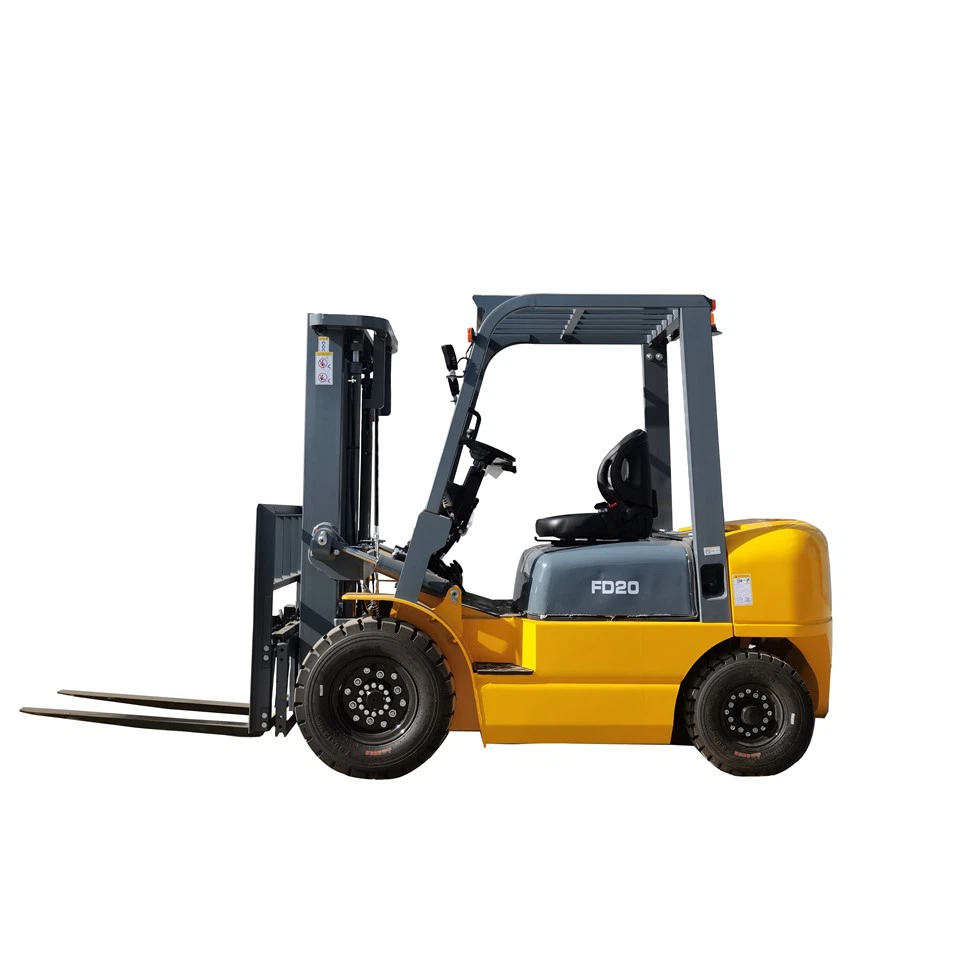

The relationship between the load center and the forklift's capacity can be calculated using the following formula:
[New\ Capacity=\frac{Rated\ Capacity\times Rated\ Load\ Center}{Actual\ Load\ Center}]
Using our example, if the rated capacity is 4 tons (8000 lbs) and the rated load center is 24 inches, and the actual load center is 36 inches, the new capacity would be:
[New\ Capacity=\frac{8000\times24}{36}\approx5333\ lbs\ or\ 2.67\ tons]
This shows that as the load center increases, the forklift's capacity decreases significantly. It's crucial for operators to be aware of this relationship to avoid overloading the forklift.
Different Load Centers in Forklift Models
Not all forklifts have the same load center. While 24 inches is a common load center for many 4 - ton diesel forklifts, there are other models available with different load centers. Some forklifts are designed for specific applications where a different load center is more appropriate.
For example, if you need to lift long, narrow loads, you might consider a forklift with a longer load center. On the other hand, if you are working in a confined space and need to maximize the forklift's maneuverability, a forklift with a shorter load center might be a better choice.
As a supplier of Forklift 4 Ton Diesel, we offer a range of models with different load centers to meet the diverse needs of our customers. Whether you are working in a large warehouse or a small manufacturing facility, we can help you find the right forklift for your specific application.
Related Forklift Products
In addition to our 4 - ton diesel forklifts, we also offer a variety of other forklift models. If you are looking for a smaller forklift, you might be interested in our Forklift Diesel 2 Tons. These forklifts are ideal for light - duty applications and are more maneuverable in tight spaces.
For heavier loads, we have 5 Ton Diesel Forklift and 8 Ton Forklift Heavy Duty options. These forklifts are designed to handle large and heavy loads with ease, making them suitable for industrial applications such as construction sites and large warehouses.
Conclusion
Understanding the load center of a 4 - ton diesel forklift is essential for safe and efficient operation. By knowing what the load center is, why it's important, and how to determine it for specific loads, operators can ensure that they are using the forklift to its maximum potential without compromising safety.
As a supplier of Forklift 4 Ton Diesel, we are committed to providing our customers with high - quality forklifts and the knowledge they need to operate them safely. If you have any questions about load centers or our forklift products, please don't hesitate to contact us. We are here to help you find the right forklift for your needs and to ensure that you get the most out of your investment.
References
- "Forklift Operator's Manual", Various manufacturers
- "Material Handling Equipment Handbook", Industrial Press Inc.
- "Safety Guidelines for Forklift Operation", Occupational Safety and Health Administration (OSHA)


