

When it comes to the world of heavy machinery, long arm excavators stand out as remarkable pieces of equipment. As a supplier of Long Arm Excavator, I often get asked about various aspects of these machines, and one question that frequently pops up is: What is the maximum speed of a long arm excavator's boom movement?
Understanding the Long Arm Excavator
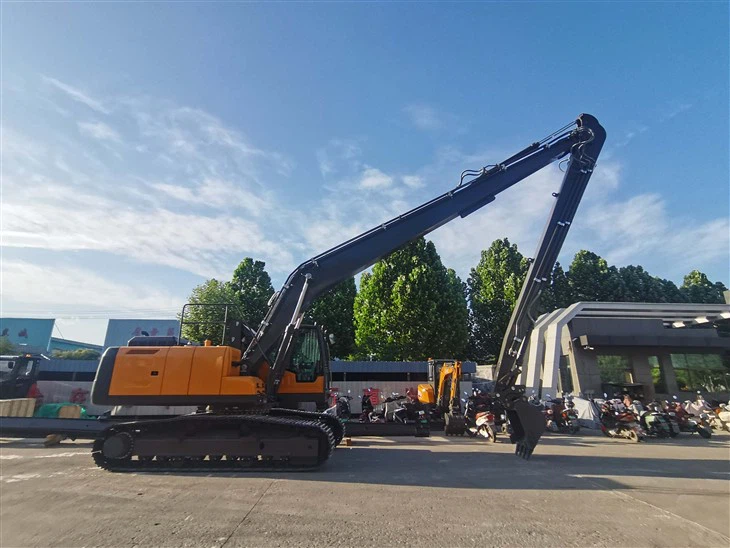
Before delving into the maximum speed of the boom movement, it's essential to understand what a long arm excavator is and its typical applications. A long arm excavator is a specialized type of excavator with an extended boom and arm, which allows it to reach greater distances compared to standard excavators. This makes it ideal for tasks such as deep excavation, river dredging, and working in areas where access is limited.
The boom of a long arm excavator is a crucial component. It is responsible for lifting, moving, and positioning the bucket or other attachments. The movement of the boom is controlled by hydraulic cylinders, which convert hydraulic pressure into mechanical force. The speed at which the boom can move depends on several factors, including the hydraulic system, the design of the boom, and the load it is carrying.
Factors Affecting the Maximum Speed of Boom Movement
Hydraulic System
The hydraulic system is the heart of a long arm excavator's boom movement. It consists of a pump, valves, and cylinders that work together to control the flow of hydraulic fluid. The capacity of the pump and the efficiency of the valves play a significant role in determining the maximum speed of the boom. A high - capacity pump can deliver more hydraulic fluid, allowing the cylinders to move the boom more quickly. Additionally, advanced valve technology can optimize the flow of fluid, reducing pressure losses and increasing the overall speed of the boom movement.
Boom Design
The design of the boom itself also affects its maximum speed. A well - designed boom will have a lightweight yet strong structure. Lightweight materials can reduce the inertia of the boom, allowing it to accelerate and decelerate more quickly. At the same time, the boom must be strong enough to withstand the forces exerted during operation. The length and shape of the boom can also influence its movement speed. A longer boom may have a slower maximum speed due to the increased leverage and the need to maintain stability.

Load
The load carried by the boom is another important factor. When the boom is carrying a heavy load, the hydraulic system has to work harder to move it. This can result in a decrease in the maximum speed of the boom movement. For example, if the excavator is lifting a large amount of soil or a heavy object, the boom will move more slowly compared to when it is operating with a lighter load.
Measuring the Maximum Speed of Boom Movement
The maximum speed of a long arm excavator's boom movement is typically measured in degrees per second or meters per second, depending on the type of movement (angular or linear). To measure the angular speed, sensors are used to detect the rotation of the boom around its pivot points. For linear speed, sensors can measure the extension or retraction of the boom along its length.
Manufacturers usually provide specifications for the maximum speed of boom movement in their product manuals. These specifications are based on ideal conditions, such as a new machine with a properly maintained hydraulic system and no external factors affecting the operation. In real - world applications, the actual maximum speed may be lower due to factors like wear and tear, environmental conditions, and the specific task being performed.
Real - World Considerations
In practical use, the maximum speed of the boom movement is not always the most important factor. Safety and precision are often more critical. For example, when working in a confined space or near sensitive structures, the operator may need to move the boom at a slower speed to ensure accurate positioning and prevent damage.
Moreover, the long arm excavator's boom movement speed needs to be balanced with other aspects of the machine's performance. For instance, if the boom moves too quickly, it may cause excessive vibrations, which can lead to premature wear of the components and affect the overall stability of the machine.
Our Long Arm Excavators
As a supplier of Long Arm Excavator, we offer a range of high - quality long arm excavators with advanced hydraulic systems and well - designed booms. Our machines are engineered to provide a good balance between speed, power, and precision.
We understand that different customers have different requirements. Whether you need a long arm excavator for large - scale excavation projects or for more delicate tasks, we can provide the right solution. Our team of experts can help you choose the most suitable model based on your specific needs, including the desired maximum speed of the boom movement.
Contact Us for Procurement
If you are interested in purchasing a long arm excavator, we encourage you to contact us for a detailed discussion. Our sales team is ready to answer all your questions and provide you with the best procurement options. We can offer competitive prices, excellent after - sales service, and technical support to ensure that your long arm excavator meets your expectations and performs optimally in your projects.
References
- Manufacturer's product manuals for long arm excavators
- Industry standards and guidelines for heavy machinery operation
- Technical papers on hydraulic systems and excavator design


