

When it comes to construction and excavation projects, breaking rocks is a common yet challenging task. Crawler excavators, a staple in the heavy machinery industry, are often the go - to equipment for this job. As a crawler excavator supplier, I am well - versed in the various methods of using these powerful machines to break rocks effectively. In this blog, I will share some of the most popular and efficient methods for breaking rocks with a crawler excavator.
1. Using a Hydraulic Hammer
One of the most common and effective methods for breaking rocks with a crawler excavator is by using a hydraulic hammer. A hydraulic hammer, also known as a hydraulic breaker, is an attachment that can be fitted to the arm of the crawler excavator. It works by using hydraulic power to deliver high - impact blows to the rock, causing it to break into smaller pieces.
The hydraulic hammer operates on the principle of converting hydraulic energy into mechanical energy. When the excavator's hydraulic system supplies pressurized fluid to the hammer, a piston inside the hammer is driven forward at high speed. This piston strikes a chisel - like tool, which then transfers the force to the rock. The repeated impacts gradually break the rock apart.
The advantage of using a hydraulic hammer is its high efficiency. It can break even the hardest rocks quickly and with relatively little effort. However, it also has some drawbacks. The noise and vibration generated by the hydraulic hammer can be significant, which may cause discomfort to the operator and nearby workers. Additionally, the wear and tear on the hammer and its components can be substantial, requiring regular maintenance and replacement.
If you are interested in a crawler excavator suitable for using a hydraulic hammer, our 21 Ton Excavator with Thumb is a great option. It has a powerful hydraulic system that can support the operation of a large - scale hydraulic hammer, allowing you to break rocks efficiently.
2. Rock Splitting
Rock splitting is another method for breaking rocks with a crawler excavator. This method involves using a rock splitter, which is an attachment that can be mounted on the excavator's arm. A rock splitter works by applying a high - pressure force to a rock, causing it to split along its natural fractures.
The rock splitter consists of a hydraulic cylinder and a wedge - shaped tool. When the hydraulic cylinder is activated, it pushes the wedge into the rock. As the wedge is forced deeper into the rock, the pressure builds up, causing the rock to crack and split. This method is particularly useful for breaking large rocks in a controlled manner, as it can minimize the amount of flying debris.
Rock splitting is a relatively quiet and vibration - free method compared to using a hydraulic hammer. It is also more precise, as it can target specific areas of the rock. However, it may be less effective for very hard or dense rocks, and the process can be time - consuming, especially for large - scale projects.
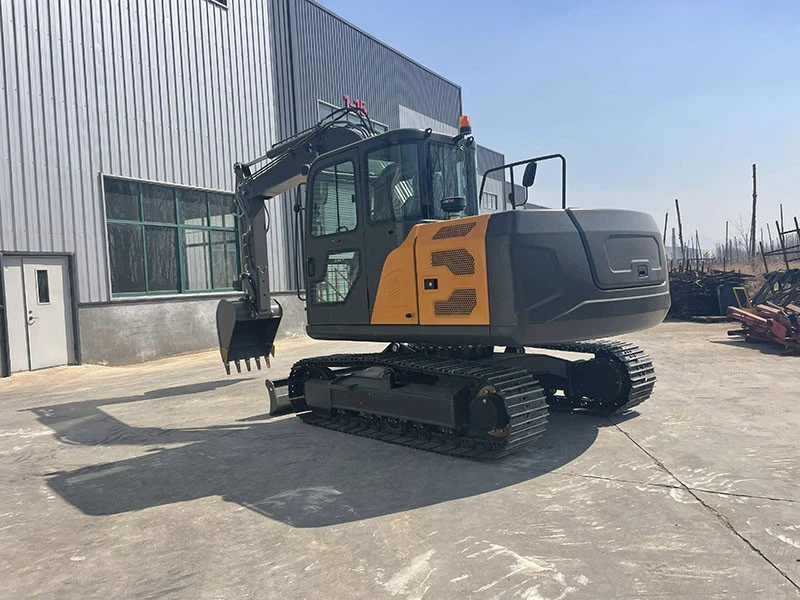

Our 6.5 Ton Excavator New Model is well - suited for rock splitting operations. Its compact size and maneuverability make it easy to access tight spaces, and its hydraulic system can provide sufficient power to operate the rock splitter effectively.
3. Drilling and Blasting
In some cases, especially for large - scale rock - breaking projects, drilling and blasting may be the most appropriate method. Although this method is not directly related to the crawler excavator's primary function, the excavator can play an important role in the process.
First, a drill is used to create holes in the rock at specific intervals. These holes are then filled with explosives. Once the explosives are detonated, the rock is broken into large chunks. After the blasting, the crawler excavator is used to remove the broken rock and clear the site.
Drilling and blasting can be a very effective method for breaking large volumes of rock quickly. However, it requires strict safety precautions and compliance with local regulations. The use of explosives also poses risks to the environment and nearby structures.
Our 9 Ton Crawler Excavator Mini Diggers can be used in the post - blasting phase to efficiently load and transport the broken rock. Its compact design allows it to work in areas with limited space, making it a versatile choice for various construction sites.
4. Crushing with Bucket Teeth
The bucket teeth of a crawler excavator can also be used to break rocks, especially for smaller rocks or in situations where other methods are not feasible. The bucket teeth are designed to penetrate and break the rock when the excavator's arm is used to apply force.
This method is relatively simple and does not require any additional attachments. However, it is less efficient for breaking large or hard rocks. The bucket teeth may also wear out quickly if used for extended periods of rock - breaking, and the impact on the excavator's bucket and arm can cause damage over time.
Factors to Consider When Choosing a Rock - Breaking Method
When deciding which method to use for breaking rocks with a crawler excavator, several factors need to be considered:
- Rock Type and Hardness: Different types of rocks have different levels of hardness. For example, granite is much harder than limestone. Harder rocks may require more powerful methods such as hydraulic hammers or drilling and blasting, while softer rocks can be broken using methods like rock splitting or crushing with bucket teeth.
- Project Scale: The size of the project is also an important factor. For small - scale projects, simpler methods like using bucket teeth or a rock splitter may be sufficient. For large - scale projects, more powerful methods like drilling and blasting or using a hydraulic hammer may be necessary.
- Environmental Considerations: Some methods, such as using a hydraulic hammer, can generate a lot of noise and vibration, which may be a concern in residential or environmentally sensitive areas. In such cases, quieter methods like rock splitting may be more appropriate.
- Cost and Efficiency: The cost of the equipment, attachments, and the time required to complete the project should also be considered. Some methods may be more expensive but offer higher efficiency, while others may be more cost - effective but take longer to complete.
Conclusion
Breaking rocks with a crawler excavator can be achieved through various methods, each with its own advantages and disadvantages. As a crawler excavator supplier, I understand the importance of choosing the right method for each project. Whether you need to break rocks for a small - scale construction site or a large - scale mining operation, we have a range of crawler excavators and attachments to meet your needs.
If you are interested in learning more about our crawler excavators or discussing your rock - breaking requirements, we invite you to contact us for a detailed consultation. Our team of experts is ready to assist you in selecting the most suitable equipment and method for your project.
References
- Construction Equipment Handbook, various editions
- Journal of Rock Mechanics and Geotechnical Engineering, multiple issues


