

Hey there! As a backhoe loader supplier, I'm super excited to dig deep into the transmission system of these awesome machines. You see, a backhoe loader is like a Swiss Army knife in the construction and excavation world. It can do so many tasks, from digging trenches to moving materials, and its transmission system is the heart that makes all these actions possible.
Let's start with the basics. The transmission system of a backhoe loader is responsible for transmitting power from the engine to the wheels and the hydraulic systems. It's a complex setup that involves several components working in harmony.
One of the key parts of the transmission system is the gearbox. The gearbox allows the operator to change the speed and torque of the backhoe loader according to the task at hand. Just like in a car, different gears are used for different situations. When you need more power, like when digging into hard soil, you'll use a lower gear. This gives you more torque, which is the rotational force that helps the machine do heavy - duty work. On the other hand, when you're moving the backhoe loader on a flat surface at a decent speed, you can shift to a higher gear.
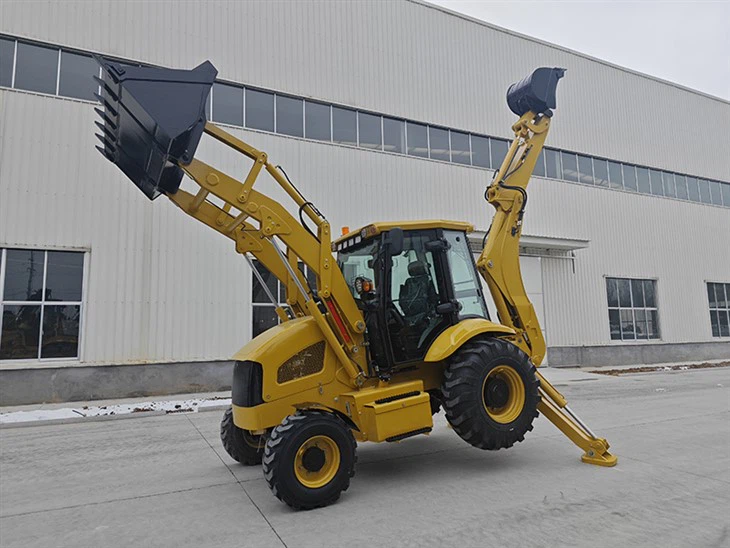

There are two main types of gearboxes commonly used in backhoe loaders: manual and automatic. Manual gearboxes give the operator full control over the gear selection. You have to physically shift the gears using a gear lever. It's a bit like driving a manual car. Some operators prefer this type because they feel more connected to the machine and can fine - tune the performance. However, it does require some skill and practice to operate smoothly, especially when you're juggling other tasks like using the loader or backhoe.
Automatic gearboxes, on the other hand, are becoming more and more popular. They use sensors and a control unit to automatically select the appropriate gear based on the speed and load of the machine. This makes it much easier for operators, especially those who are new to backhoe loaders. You don't have to worry about shifting gears at the right time, and you can focus more on the actual work. It also reduces operator fatigue, which is a big plus when you're working long hours on a construction site.
Another important component of the transmission system is the clutch. In a manual transmission backhoe loader, the clutch is used to engage and disengage the engine from the gearbox. When you press the clutch pedal, it separates the engine from the transmission, allowing you to shift gears smoothly. Releasing the clutch pedal re - connects the engine to the gearbox, and power is transmitted to the wheels. In an automatic transmission, the clutch operation is automated, and the driver doesn't have to worry about it.
The drive shafts are also crucial. They transfer the power from the gearbox to the wheels. There are usually two drive shafts in a backhoe loader: one for the front wheels and one for the rear wheels. Some backhoe loaders have four - wheel drive capabilities, which means that power can be sent to all four wheels simultaneously. This gives the machine better traction, especially in rough or slippery terrain. When you're working on a muddy construction site or a sloped surface, four - wheel drive can really make a difference in terms of performance and safety.
The differential is another vital part of the transmission system. Its main function is to allow the wheels on the same axle to rotate at different speeds. When the backhoe loader is turning, the outer wheels have to cover a greater distance than the inner wheels. The differential enables this to happen smoothly, preventing the wheels from skidding or binding. Without a properly functioning differential, the machine would be difficult to steer and could cause unnecessary wear and tear on the tires.
Now, let's talk about the hydraulic system, which is closely related to the transmission system. The hydraulic system in a backhoe loader is used to power the loader and the backhoe attachments. It uses hydraulic fluid to transmit force and motion. The power for the hydraulic system comes from the engine, and it's regulated by the transmission system. When you operate the controls to lift the loader bucket or extend the backhoe arm, the hydraulic system responds by moving the cylinders that control these actions.
As a backhoe loader supplier, I know how important it is to have a reliable transmission system. A well - maintained transmission system ensures that the machine operates smoothly, efficiently, and safely. Regular maintenance, such as changing the transmission fluid, checking the clutch (if it's a manual transmission), and inspecting the drive shafts and differentials, can go a long way in preventing breakdowns and extending the lifespan of the backhoe loader.
If you're in the market for a backhoe loader, you might want to check out our New Mini Backhoe Loader. It's a great option for those who need a compact yet powerful machine. It comes with a state - of - the - art transmission system that offers excellent performance and ease of use. Whether you're a small construction company or a DIY enthusiast, this mini backhoe loader can get the job done.
In conclusion, the transmission system of a backhoe loader is a complex but essential part of the machine. It's what allows the backhoe loader to perform a wide range of tasks with precision and power. If you're interested in learning more about our backhoe loaders or have any questions about the transmission system, don't hesitate to reach out. We're here to help you find the perfect backhoe loader for your needs and ensure that you get the most out of your investment.
References
- Construction Equipment Handbook
- Machinery's Handbook


