

Hey there! As a wheel excavator supplier, I often get asked about all sorts of technical details regarding these machines. One question that pops up quite frequently is, "What is the minimum ground clearance of a wheel excavator?" Well, let's dive right into it and break it down.
First off, what exactly is ground clearance? Simply put, it's the distance between the lowest point of the wheel excavator (usually the undercarriage or the lowest part of the frame) and the ground. This measurement is crucial because it determines how well the excavator can navigate different terrains without getting stuck or damaged.
Now, the minimum ground clearance of a wheel excavator can vary depending on several factors. One of the biggest factors is the size and model of the excavator. Generally speaking, larger excavators tend to have a higher minimum ground clearance compared to smaller ones. This is because they are designed to handle more challenging terrains and larger loads.
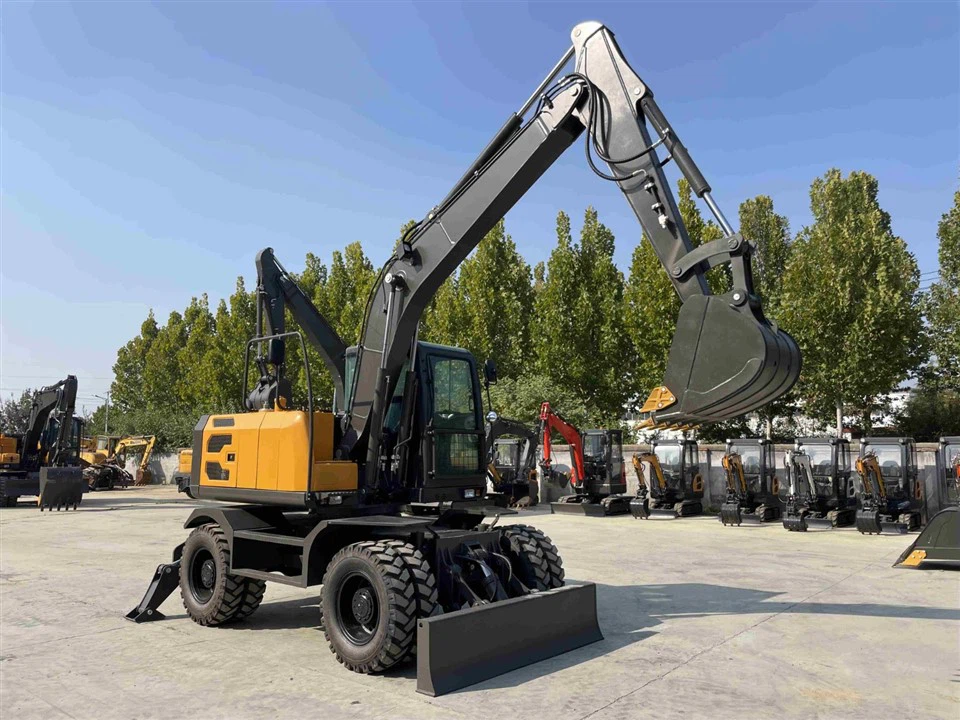
For instance, our Wheel Excavator 20 Ton 21.5 Ton has a relatively high minimum ground clearance. This is because these heavy - duty machines are often used in construction sites where the ground can be uneven, full of rocks, or have other obstacles. A higher ground clearance allows them to drive over these obstacles without scraping the undercarriage.
On the other hand, our Wheel Excavator 15 Ton Excavator has a slightly lower but still adequate minimum ground clearance. These mid - sized excavators are more versatile and can be used in a variety of settings, from small construction projects to landscaping jobs. The ground clearance is optimized to balance between maneuverability and the ability to handle moderately rough terrains.
Our 12 Ton Wheel Excavator is even more compact. It's great for jobs in tight spaces or areas with less demanding terrains. So, its minimum ground clearance is set at a level that provides enough clearance for normal operation while still allowing for easy movement in confined areas.
Another factor that affects the minimum ground clearance is the type of tires used. Different tires have different thicknesses and profiles, which can either increase or decrease the overall ground clearance. For example, off - road tires with a thicker tread and more aggressive pattern usually increase the ground clearance slightly. This is because they add more height between the ground and the undercarriage.
The suspension system of the wheel excavator also plays a role. A well - designed suspension can adjust the height of the machine based on the load and the terrain. Some modern wheel excavators come with adjustable suspension systems that can raise or lower the machine to optimize the ground clearance. This is really handy when you need to switch between different types of jobs or terrains.
Why is the minimum ground clearance so important? Well, if the ground clearance is too low, the excavator can get stuck on small obstacles like rocks or bumps. This not only slows down the work but can also cause damage to the undercarriage, which can be expensive to repair. On the other hand, if the ground clearance is too high, the machine may become less stable, especially when turning or operating on slopes.
When choosing a wheel excavator, you need to consider the type of work you'll be doing. If you're working on a construction site with a lot of debris and uneven ground, you'll want an excavator with a higher minimum ground clearance. But if you're doing mostly indoor or small - scale jobs, a lower ground clearance might be just fine.
Let's talk about some typical minimum ground clearance values. For small wheel excavators, the minimum ground clearance can be around 200 - 250 millimeters. This is suitable for light - duty work on relatively flat surfaces. Mid - sized wheel excavators usually have a minimum ground clearance of 250 - 350 millimeters. This allows them to handle a wider range of terrains. And for large wheel excavators, the minimum ground clearance can be 350 millimeters or more, which is ideal for heavy - duty construction and rough terrains.
It's also important to note that the minimum ground clearance can change depending on the configuration of the excavator. For example, if you add additional attachments or equipment to the machine, it can lower the overall ground clearance. So, when you're calculating the effective ground clearance for your specific job, you need to take these factors into account.
In addition to the terrain and the type of work, you also need to think about the transportation of the wheel excavator. If you need to transport the machine on a trailer, the ground clearance can affect how easily it can be loaded and unloaded. A machine with a very high ground clearance may require a special trailer or loading ramp.
As a wheel excavator supplier, we understand the importance of getting the right ground clearance for your needs. That's why we offer a wide range of wheel excavators with different minimum ground clearances. Whether you're a small contractor or a large construction company, we have a machine that will fit your requirements.
If you're in the market for a wheel excavator, don't hesitate to reach out to us. We can help you choose the right model based on your specific needs, including the minimum ground clearance. Our team of experts is always ready to answer your questions and provide you with all the information you need to make an informed decision.
So, if you're interested in purchasing a wheel excavator, or if you have any further questions about minimum ground clearance or any other aspect of our products, just let us know. We're here to help you get the most out of your wheel excavator investment.
References:

- General knowledge of wheel excavator design and operation
- Manufacturer's specifications for different wheel excavator models


