

When it comes to heavy - duty construction equipment, the long arm excavator stands out as a remarkable piece of machinery. As a supplier of Long Arm Excavator, I am often asked about the maximum speed of these mobile long arm excavators. In this blog, we will delve into the factors that influence the speed of long arm excavators and try to determine their maximum achievable speed.
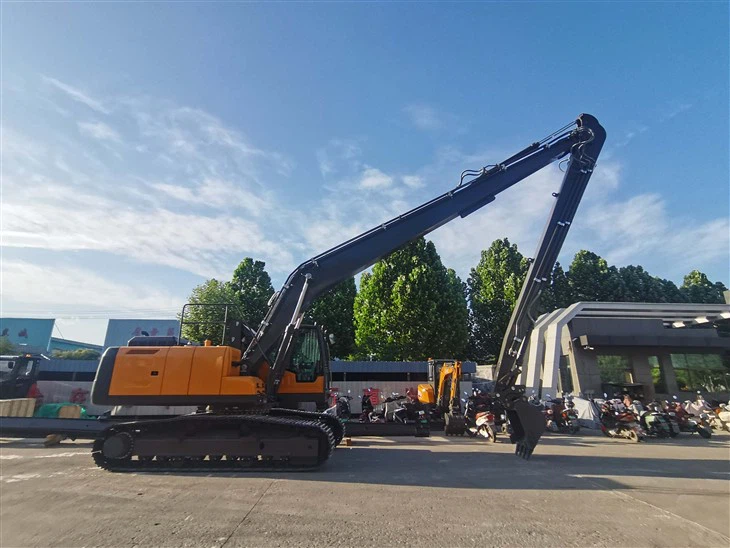

Understanding the Long Arm Excavator
A long arm excavator is a specialized type of excavator with an extended arm, which allows it to reach greater distances and depths compared to standard excavators. These machines are commonly used in large - scale construction projects, such as dam building, river dredging, and large - area earthmoving. The long arm design gives them unique capabilities but also presents certain challenges, especially when it comes to mobility and speed.
Factors Affecting the Speed of a Long Arm Excavator
1. Engine Power
The engine is the heart of any excavator. A more powerful engine can generate more torque and horsepower, which are essential for moving the heavy machinery. Long arm excavators typically require a high - power engine to handle the additional weight of the long arm and the load it can carry. For example, a large - scale long arm excavator may be equipped with a diesel engine with a power output of several hundred horsepower. The more power the engine has, the faster the excavator can potentially move, as it can overcome the resistance from the ground and the weight of the machine itself.
2. Weight and Balance
Long arm excavators are heavier than standard excavators due to the extended arm and additional structural components. The extra weight can slow down the machine, as more energy is required to move it. Moreover, maintaining balance is crucial. The long arm can shift the center of gravity of the excavator, which may limit the speed to ensure stability. If an excavator moves too fast, there is a risk of tipping over, especially when making turns or operating on uneven terrain.
3. Terrain Conditions
The type of terrain on which the long arm excavator operates has a significant impact on its speed. On flat, hard surfaces such as concrete or asphalt, the excavator can move relatively faster. However, on soft ground, such as mud or sand, the machine may sink, increasing the resistance and reducing the speed. In addition, rough and uneven terrain, like hilly areas or rocky ground, can also slow down the excavator as it has to navigate over obstacles and maintain stability.
4. Transmission System
The transmission system of a long arm excavator is responsible for transferring power from the engine to the tracks or wheels. A well - designed transmission system can optimize the power transfer and improve the speed of the machine. There are different types of transmission systems, such as mechanical, hydraulic, and hydrostatic. Hydraulic and hydrostatic transmissions are more commonly used in modern long arm excavators as they offer better control and efficiency.
What is the Maximum Speed?
The maximum speed of a long arm excavator can vary significantly depending on the factors mentioned above. Generally, the maximum travel speed of a long arm excavator on a flat, hard surface ranges from 2 to 6 kilometers per hour. Some smaller and more agile long arm excavators may be able to reach speeds closer to 6 km/h, while larger, heavier models may have a maximum speed closer to 2 km/h.
It's important to note that these speeds are for travel purposes only. When the excavator is in operation, such as digging or lifting, the speed is much slower. During excavation work, the focus is on precision and control rather than speed. The long arm needs to be maneuvered carefully to ensure accurate digging and avoid damage to the equipment or the surrounding environment.
Applications and Speed Requirements
In different applications, the speed requirements of long arm excavators vary. For example, in large - scale earthmoving projects where the excavator needs to cover a large area quickly, a relatively higher travel speed is desirable. However, in tasks such as river dredging or precision excavation near sensitive structures, speed is less important than accuracy and stability.
As a Supplier
As a supplier of Long Arm Excavator, we understand the importance of providing machines that meet the specific needs of our customers. We offer a range of long arm excavators with different engine powers, arm lengths, and speed capabilities. Our team of experts can help you select the right excavator based on your project requirements, including the terrain, the type of work, and the desired speed.
If you are in the market for a long arm excavator, we encourage you to contact us for a detailed discussion. Our sales team is ready to answer all your questions and provide you with the best solutions for your construction needs. Whether you need a high - speed excavator for large - scale projects or a more stable and precise machine for delicate work, we have the expertise and the products to meet your demands.
Conclusion
In conclusion, the maximum speed of a long arm excavator is influenced by multiple factors, including engine power, weight and balance, terrain conditions, and the transmission system. While the maximum travel speed on a flat, hard surface typically ranges from 2 to 6 km/h, the actual speed used in different applications may vary. As a supplier, we are committed to providing high - quality long arm excavators that offer the right balance between speed, power, and precision. If you are interested in our products, please reach out to us for further information and to start the procurement process.
References
- Construction Equipment Handbook, various editions
- Manufacturer's specifications for long arm excavators


