

A backhoe loader is a versatile piece of heavy - machinery that combines the functionality of a tractor, a loader, and an excavator. This multifaceted equipment is widely used in construction, agriculture, and utility projects due to its ability to perform a wide range of tasks. As a backhoe loader supplier, I'm here to delve into the main components of these remarkable machines, enabling you to understand their operations better and make informed purchasing decisions.
1. Chassis
The chassis serves as the backbone of the backhoe loader. It provides a sturdy platform that supports all the other components and bears the weight of the machine, as well as any loads it carries during operation. Usually made from high - strength steel, the chassis is designed to withstand significant stress and vibration. It must be strong enough to handle the dynamic forces exerted during digging, lifting, and loading operations.
The design of the chassis also affects the machine's stability. A well - engineered chassis distributes the weight evenly across the wheels or tracks, ensuring that the backhoe loader remains stable even on uneven terrain. This stability is crucial for safe and efficient operation, especially when performing tasks at height or with heavy loads.
2. Engine
The engine is the power source of the backhoe loader. Most backhoe loaders are equipped with diesel engines, which are known for their high torque and fuel efficiency. Diesel engines can generate a large amount of power, allowing the machine to perform heavy - duty tasks such as digging through hard soil or lifting heavy materials.
The power output of the engine is typically measured in horsepower (HP). The higher the horsepower, the more powerful the machine, and the more demanding tasks it can handle. Modern backhoe loader engines are also designed to meet strict environmental regulations, with features such as advanced fuel injection systems and exhaust after - treatment technologies to reduce emissions.
3. Cab
The cab is where the operator sits and controls the backhoe loader. It is designed to provide a comfortable and safe working environment. The cab is usually sound - insulated to reduce noise levels, which helps to prevent operator fatigue during long working hours.
Inside the cab, there are various controls and instruments that allow the operator to manage the machine's functions. These include steering wheels, pedals, levers, and a dashboard with gauges for monitoring engine temperature, fuel level, and other important parameters. Some modern cabs are also equipped with air - conditioning and ergonomic seats to enhance operator comfort.
Safety features in the cab are of utmost importance. It is typically equipped with a roll - over protective structure (ROPS) and a falling - object protective structure (FOPS) to protect the operator in case of an accident.
4. Loader Assembly
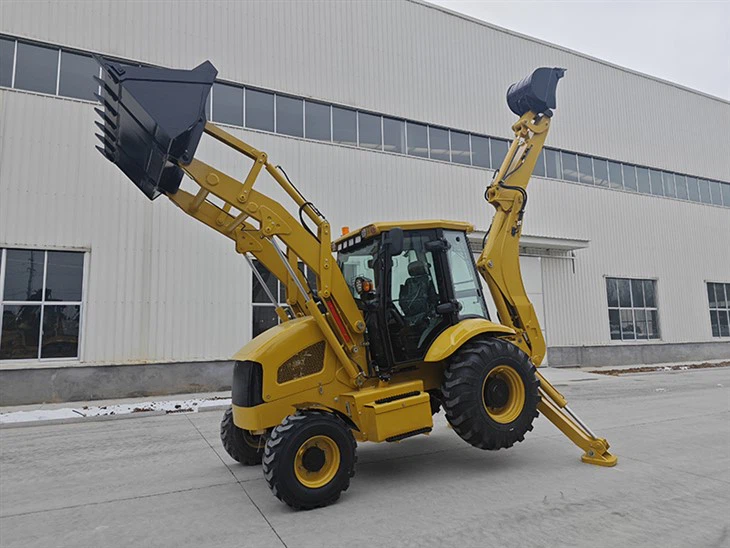
The loader assembly is located at the front of the backhoe loader. It consists of a pair of loader arms, a bucket, and hydraulic cylinders. The loader arms are long, sturdy structures that are attached to the chassis. They can be raised and lowered using hydraulic power, allowing the bucket to pick up and deposit materials.
The bucket is the part of the loader assembly that comes into direct contact with the materials. It is available in different sizes and shapes, depending on the specific application. For example, a wide bucket is suitable for moving large volumes of loose materials such as sand or gravel, while a smaller, more specialized bucket may be used for more precise tasks.
The hydraulic cylinders are responsible for powering the movement of the loader arms and the bucket. They convert the hydraulic pressure generated by the hydraulic system into mechanical force, enabling the loader assembly to perform its functions efficiently.
5. Backhoe Assembly
The backhoe assembly is located at the rear of the backhoe loader. It is used for digging, trenching, and other excavation tasks. The backhoe consists of a boom, a dipper stick, a bucket, and a set of hydraulic cylinders.
The boom is the large, upper arm of the backhoe. It is attached to the chassis and can be pivoted horizontally and vertically using hydraulic power. The dipper stick is connected to the boom and can be extended and retracted, allowing the bucket to reach different depths and distances.
The bucket at the end of the dipper stick is designed for digging. It has sharp teeth on the edge to break through the soil and can be tilted to scoop up the excavated material. Similar to the loader assembly, the movement of the backhoe components is powered by hydraulic cylinders.

6. Hydraulic System
The hydraulic system is the heart of the backhoe loader's operation. It powers the movement of the loader and backhoe assemblies, as well as other functions such as steering and braking in some models. The hydraulic system consists of a hydraulic pump, hydraulic fluid, hydraulic hoses, valves, and cylinders.
The hydraulic pump is driven by the engine and is responsible for generating the hydraulic pressure. The hydraulic fluid acts as the medium for transmitting the power. It is stored in a reservoir and circulated through the system by the pump.
The hydraulic hoses carry the hydraulic fluid from the pump to the valves and cylinders. The valves control the flow and direction of the hydraulic fluid, allowing the operator to control the movement of the different components.
7. Wheels or Tracks
Backhoe loaders can be equipped with either wheels or tracks, depending on the application and operating conditions.
Wheel - based backhoe loaders are more common and offer greater mobility on hard - surfaced roads and flat terrain. They can be easily driven to different job sites and are generally faster to travel between locations. However, they may have less traction on soft or uneven ground.
Track - based backhoe loaders, on the other hand, provide better stability and traction on rough, muddy, or soft terrain. The tracks distribute the weight of the machine over a larger area, reducing the ground pressure and preventing the machine from sinking. However, they are generally slower and more difficult to transport compared to wheel - based models.
8. Transmission
The transmission is responsible for transferring the power from the engine to the wheels or tracks. There are different types of transmissions available in backhoe loaders, including manual and automatic transmissions.
Manual transmissions require the operator to manually shift gears, which gives them more control over the machine's speed and power. Automatic transmissions, on the other hand, automatically adjust the gear ratio based on the machine's speed and load, making them easier to operate, especially for less - experienced operators.
9. New Mini Backhoe Loader
If you're looking for a more compact and agile option, our New Mini Backhoe Loader might be the perfect choice. Despite its smaller size, it retains all the key components and functionality of a full - sized backhoe loader. It is ideal for working in tight spaces, such as urban construction sites or small - scale agricultural projects.
Our new mini backhoe loader is equipped with a fuel - efficient engine, a comfortable cab, and powerful hydraulic systems for its loader and backhoe assemblies. Whether you need to dig small trenches, load light materials, or perform other tasks, this mini backhoe loader can get the job done.
As a backhoe loader supplier, we understand the importance of having reliable and high - performance equipment for your projects. We offer a wide range of backhoe loaders, from mini - models to large, heavy - duty machines, designed to meet your specific needs. If you're interested in learning more about our products or are considering a purchase, we encourage you to contact us for a detailed discussion. Our team of experts is ready to provide you with all the information you need and guide you through the purchasing process.
References
- Construction Equipment Technology Handbook, Publishers Group
- Heavy Machinery Mechanics Manual, Industrial Press
This is a comprehensive overview of the main components of a backhoe loader, hoping to help you have a deeper understanding of these machines, and look forward to your inquiry for potential cooperation.


